Kalshi Launches Professional Trading Terminal for Prediction Markets
Kalshi, a CFTC-regulated prediction market platform, is alpha testing a new professional-grade trading terminal modeled after the Bloomberg Terminal. This move follows a significant $1 billion funding round and aims to attract institutional traders by enhancing the trading experience with advanced features.
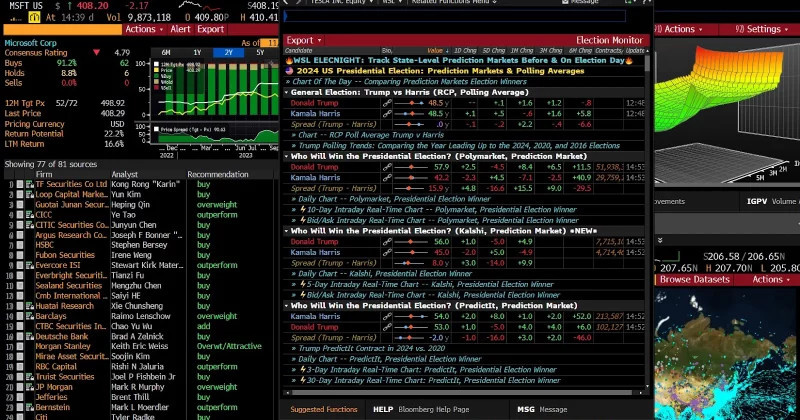
Kalshi is making waves in the prediction market space by developing a professional-grade trading terminal that aims to elevate the trading experience for its most serious users. The new interface, currently in alpha testing, is designed to resemble the Bloomberg Terminal, providing traders with a robust platform to manage multiple event contract positions, access live trading data, and execute trades with minimal friction. This shift signals Kalshi's ambition to move beyond being just a consumer-facing betting app and cater to institutional adoption after a substantial $1 billion funding round.
The recent funding round, completed in May 2026, valued Kalshi at an impressive $22 billion and included notable investors such as Coatue, Sequoia, and a16z. With an annualized trading volume reported at $178 billion, Kalshi claims to account for over 90% of U.S. prediction market activity. The new terminal, which has been in development for about a month, is a strategic move to attract professional traders who require advanced tools for multi-position management and real-time data feeds.
Kalshi isn't alone in this endeavor; competitors like Paradigm, Verso, and Panther are also working on similar trading terminals aimed at professional users. The race is on to capture the growing interest in institutional trading within the prediction market space. The breadth of contracts driving this growth encompasses a wide range of topics, including elections, sports, economic indicators, and even niche events.
Kalshi's Regulatory Edge Enhances Market Competitiveness
The regulatory clarity provided by Kalshi's CFTC-regulated status gives it a competitive edge over other platforms, particularly with institutional allocators who prioritize compliance when deploying capital. Professional traders typically engage in larger order sizes and more consistent activity, leading to tighter spreads on event contracts, which ultimately benefits all participants in the market.
Can Kalshi Sustain Its Advantage Amidst Growing Competition?
As the competition heats up, the differentiation among platforms will likely hinge on aspects such as data quality, execution speed, contract variety, and fee structures. Kalshi's early lead in both trading volume and regulatory standing positions it favorably against its rivals. Investors are optimistic about the platform's growth potential, as indicated by its $22 billion valuation in light of its substantial trading volume.
With the prediction market landscape evolving rapidly, Kalshi's focus on creating a terminal that meets the needs of institutional traders could redefine how these markets operate and attract larger trades, enhancing overall market efficiency. As we watch this space, the question remains: will Kalshi's innovations set a new standard for prediction markets, or will its competitors catch up and challenge its dominance?